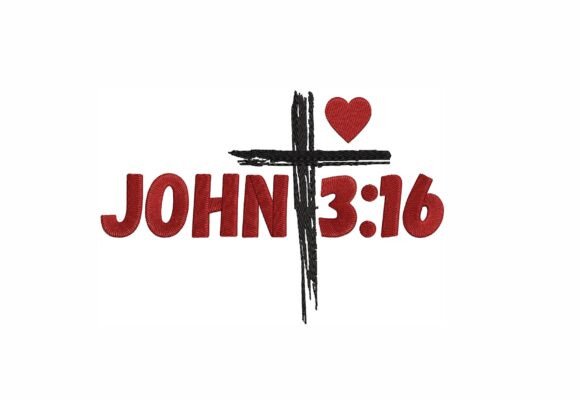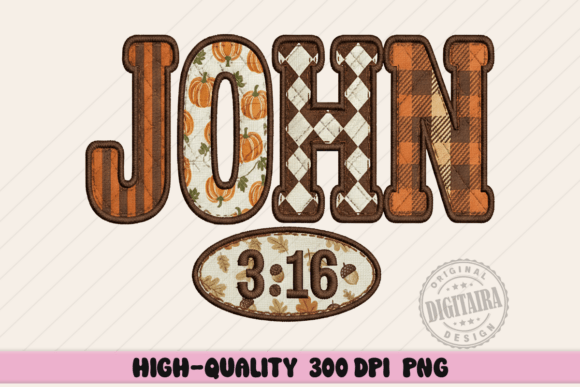
Christian John 3:16 Faux Embroidery PNG
As a designer who’s stitched hundreds of faith-based pieces—from baby onesies to boutique aprons—I opened Christian John 3 16 Faux Embroidery Png expecting something clean and reverent. What I found was more nuanced: a quiet, confident visual statement that leans into readability over ornamentation. It’s not flashy embroidery—it’s intentional embroidery. That distinction matters when you’re choosing design assets for real projects, not just digital previews.
A Design That Speaks Before the Needle Moves
The first thing that stands out is its balance: centered composition, generous letter spacing, and subtle faux-stitch texture layered just enough to suggest handcrafted care—without overwhelming the text. There’s no decorative border, no floral frame, no halo or cross graphic. Just John 3:16, rendered in a dignified serif with soft shadowing that mimics satin stitch depth. It feels like a design made for *people*, not algorithms—meant to be seen on a folded kitchen towel at a church bazaar or stitched onto the chest of a newborn’s cotton onesie.
I immediately pictured it on a natural linen tote bag—something sturdy, unbleached, with visible weave. The transparency of the PNG means it drops cleanly into mockup tools, but more importantly, it translates well to actual digitizing. Since this is a faux embroidery graphic—not a machine embroidery file—it’s best treated as a high-fidelity reference or print-ready asset. Think of it as your visual north star before converting to stitch files or using directly for screen printing, iron-on transfers, or printable patches.
Where This Design Earns Its Keep (and Where It Needs Care)
It shines on medium-to-large surfaces where clarity and calm matter: sweatshirt fronts, pillow covers for nursery decor, tea towels for holiday gifting, and custom aprons for small-batch bakeries or faith-based cafés. Because the lettering is generous and legible at 3–4 inches wide, it holds up beautifully on textured fabrics like terry cloth or heavy cotton duck—no lost detail in the nap.
Use caution on curved or tight spaces: caps, beanies, or tiny baby hats will compress the proportions unless resized thoughtfully. On stretchy knits (like lightweight jersey tees), avoid placing it near seams or side panels without testing stabilizer support—thin fabric + dense faux-stitch texture can blur under tension. And while the 300 DPI resolution gives sharp edges for digital use, remember: if you’re converting this into a machine embroidery design yourself, fine lettering requires careful digitizing—especially those serifs and internal counters. Don’t assume automatic trace tools will honor the subtlety.
Real Project Test: A Baptism Gift Bundle
Last month, I prepped a baptism gift set: a white cotton blanket, a matching burp cloth, and a drawstring bag—all personalized with scripture. I used Christian John 3 16 Faux Embroidery Png as the base for mockups, then worked with my digitizer to build clean, low-density satin-stitch lettering optimized for baby-soft fabrics. Why start here? Because the PNG’s balanced weight and spacing gave us an accurate starting point for stitch count and hoop size planning. Had the original been cramped or overly ornate, we’d have wasted time adjusting kerning or simplifying outlines.
Customers responded strongly—not to “how pretty it is,” but to how *grounded* it felt. One buyer wrote, “It doesn’t shout. It rests.” That’s the power of restraint in faith-based design. It supports the message instead of competing with it.
What This Means for Your Craft Business
If you’re an Etsy seller or small shop owner building a cohesive line—say, “Grace & Grain” kitchen textiles or “Little Light” baby collections—Christian John 3 16 Faux Embroidery Png functions as reliable, brand-aligned design assets. It pairs naturally with neutral palettes, minimalist packaging, and handwritten product tags. It doesn’t demand bold thread colors to read; it works in ecru on oatmeal, navy on cream, or charcoal on heather grey.
But let’s be practical: since this is a Graphics-category digital product—not an Illustrations file meant for scaling infinitely—you’ll want to verify your intended output size before purchase. At 300 DPI, it’s ideal for prints up to ~8x10", but pushing beyond that may soften edges. For apparel decorators, treat it as a foundation—not a final stitch file. Always test on scrap fabric first. Check contrast between thread colors and your base fabric in both natural and artificial light. Run black-and-white mockups to confirm legibility on dark backgrounds.
Designer Notes You’ll Actually Use
- Test before committing: Print or stitch a sample on your target fabric—even if it’s just a 2" square. See how the letterforms hold up after washing or steaming.
- Stabilizer isn’t optional: Especially on lightweight or loosely woven materials, use cutaway or tear-away backing to prevent puckering around dense areas.
- Thread color strategy: This design gains warmth with matte cotton thread—not glossy polyester. Try tonal shades (e.g., warm grey on oatmeal) for quiet sophistication.
- Licensing check: Since this is a digital product sold as a PNG, confirm whether your intended use (e.g., selling embroidered tote bags on Etsy) falls within the seller’s commercial terms. When in doubt, reach out before listing.
- Mockup wisely: Drop the transparent PNG into layered mockups—light fabric, dark fabric, textured fabric—to preview how it reads across your full product range.
Final Thought: Less Is Anchored
In a market flooded with ornate, over-digitized scripture designs, Christian John 3 16 Faux Embroidery Png stands out by doing less—and meaning more. It doesn’t try to be everything. It’s a focused, respectful, production-ready asset for makers who value clarity, craftsmanship, and quiet intention. Whether you’re stitching a single personalized gift or building a scalable craft business, this design earns its place not through novelty, but through reliability. And in embroidery—where every stitch carries weight—that’s the highest compliment.