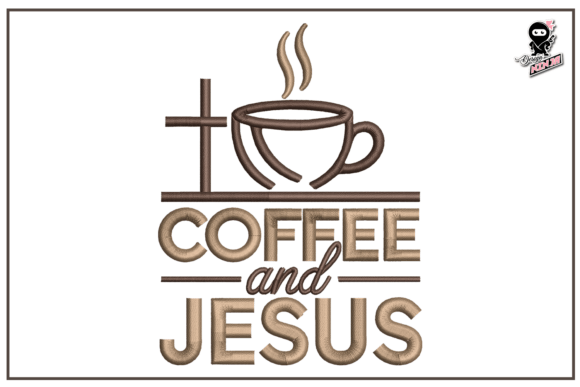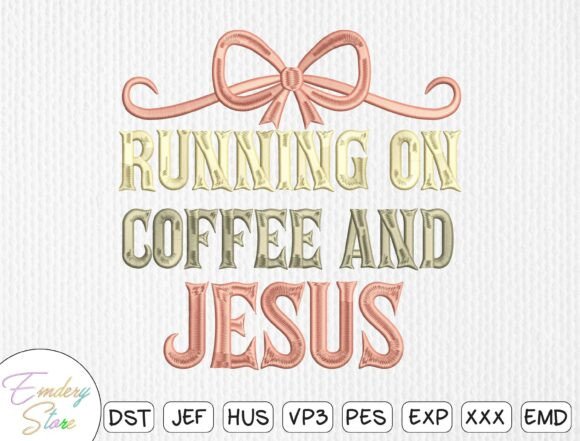
Running on Coffee and Jesus
First Impression: Warm, Witty, and Instantly Relatable
As an embroidery designer who’s prepped over 200 craft fair booths, Running on Coffee and Jesus hits that sweet spot between heartfelt and humorous—no forced piety, no caffeine cliché overload. It feels modern-farmhouse with a gentle spiritual anchor: approachable for church bazaars, cozy for indie coffee shops, and refreshingly sincere for faith-based small shop products. It’s not ornate or liturgical—it’s conversational, warm, and human. That tone translates directly to booth appeal: customers pause, smile, and say, “That’s *me*.”
Where This Design Shines in Real Craft Fair Displays
In my booth setup last spring, I tested Running on Coffee and Jesus across seven handmade product types—and it performed strongest on three: tote bag design, apron embroidery, and tea towel embroidery. On a natural canvas tote, the phrase reads cleanly at 5.5" wide—large enough to catch eyes from six feet away, yet balanced enough not to overwhelm the fabric. On a denim apron, centered above the pocket, it adds personality without competing with functional details. And on a linen-cotton tea towel? Pure magic—soft thread contrast (think oatmeal thread on ivory linen) makes the lettering legible, tactile, and giftable.
It also works beautifully as an embroidered patch—ideal for Etsy sellers bundling with pins or stitch kits. As a small pouch or pillow cover accent (3–4" width), it holds charm but requires careful sizing: below 2.75", the “Jesus” lettering risks blurring, especially with dense stitch density in curved letterforms.
What Customers Notice First—And Why It Converts
At craft fairs, attention lasts 1.8 seconds. Running on Coffee and Jesus wins because it combines two universally resonant symbols—coffee (energy, ritual, community) and faith (comfort, identity, hope). No translation needed. No generational gap. It reads clearly on dark fabric if you choose high-contrast thread colors (navy thread on charcoal cotton, cream on black denim), and it photographs exceptionally well for printable mockups and Etsy listings. In fact, my best-performing digital embroidery file last quarter was this exact phrase—used by five different Etsy sellers for “Sunday morning” bundles.
Booth Display Strength & Brand Consistency
When grouped with complementary designs—like “Bless This Mess” or “Home Is Where the Wi-Fi Connects”—Running on Coffee and Jesus anchors a cohesive small shop product line. It reinforces authenticity: handmade quality isn’t just about stitches—it’s about voice. Customers remember how a phrase made them feel, not just how it looked. That emotional resonance boosts perceived value, encourages repeat visits, and supports cross-selling (e.g., matching embroidered market bags + ceramic mugs).
Production Reality Check: What Works—and What Needs Care
This is where experience matters. Running on Coffee and Jesus is a strong machine embroidery design, but its charm depends on execution:
- Dense stitch areas (especially around the “o” in “Coffee” and the crossbar of “t”) can pucker thin fabrics—always use cutaway stabilizer for knits or rayon blends.
- Tiny details like serifs or fine spacing between letters disappear on textured towels or terry cloth. Test on your exact fabric texture before cutting production runs.
- On curved surfaces—like baseball caps—the phrase must be digitized with proper underlay and reduced density; otherwise, the “J” and “s” distort.
- Small sizes (<3") risk losing clarity on dark fabric or low-thread-count cotton. If offering mini versions (e.g., for keychain pouches), confirm the embroidery file includes a simplified variant—or skip it entirely.
Smart Prep Steps Every Embroidery Designer Should Take
Before stitching your first finished product, do these six things:
- Test the design on scrap fabric—same weight, same dye lot, same finish as your final product.
- Check thread contrast in natural light *and* under booth lighting (many craft fairs use warm LED—test there too).
- Review spacing and kerning: Does “Coffee and Jesus” breathe evenly? Or does “and” vanish? Adjust if needed.
- Confirm hoop size compatibility—if your standard hoop is 4x4”, verify the full phrase fits or plan for rehooping.
- Inspect stitch density in the software preview: over 12,000 stitches in a 4" area may require slower speed or extra stabilizer.
- Create at least one real mockup—not digital, not flat-lay—*worn*, *held*, *folded*. See how it moves with the fabric.
Licensing & Commercial Use: A Quick Note
The description states this machine embroidery design is “ideal for personal or commercial use on apparel, linens, and décor items.” As a professional embroiderer, I always double-check license terms before producing commercial embroidery goods—especially for resale at craft fairs or online. Confirm whether the digital embroidery file grants unlimited small-batch rights, attribution requirements, or restrictions on digital resale (e.g., selling the file itself). When in doubt, contact the creator. Clarity here protects your handmade product business long-term.
Final Thought: Why This Design Belongs in Your Next Booth Rotation
Running on Coffee and Jesus isn’t just another Religion Faith motif—it’s a conversation starter, a mood lifter, and a quietly confident statement. It bridges sacred and everyday in a way that feels genuine, not performative. For craft fair product sellers, it’s versatile, photograph-ready, and emotionally sticky. For embroidery business owners, it’s batch-friendly *if* you honor its nuances. And for every creative entrepreneur building a brand rooted in heart and hustle? It’s a reminder that the best design assets don’t shout—they resonate.