Truth Sets Us Free Applique
As a designer who’s stitched hundreds of faith-based embroidery files for clients, boutique shops, and Etsy sellers over the past twelve years, I approach each new design with two questions: Does it translate cleanly from screen to fabric? and Will it hold up—not just in stitch, but in meaning—on a real product? When I opened Truth Sets Us Free Applique, I felt that quiet resonance you get when a design lands right: bold enough to command attention, graceful enough to invite reflection.
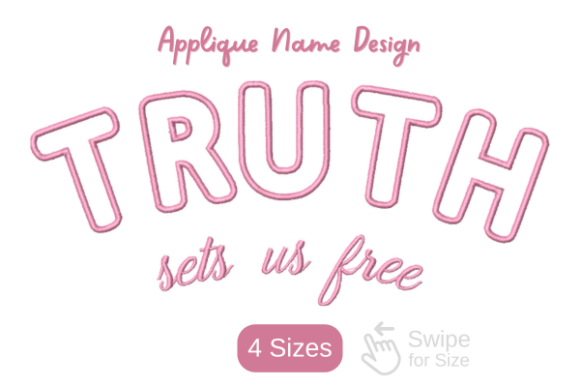
I tested it first on a natural linen tote bag—something I’d actually sell in my own small shop. The layout is smart: uppercase “TRUTH SETS US FREE” in clean, confident applique lettering anchors the piece, while the script “truth sets us free” flows beneath like a whispered promise. It’s not cluttered. There’s breathing room between elements, and the satin-stitched edges on the applique letters hold crispness without excessive density. That matters—especially when stitching on textured fabrics like canvas or medium-weight cotton twill.
This isn’t a design that shouts. It breathes. And that makes it unusually versatile across real-world use cases. On a soft unisex sweatshirt? Yes—it reads clearly at 4.5 inches wide, even from across a room. On a baby onesie? I scaled it down to 3.25 inches and used lightweight tear-away stabilizer; the script remained legible, though I’d avoid going smaller than that for infant wear. As an embroidered patch? Perfect. The clean outer edge and balanced negative space make it easy to trim and fuse. On a tea towel or pillow cover? It adds quiet intention—not decoration for decoration’s sake, but a grounded visual anchor in everyday spaces.
Where Truth Sets Us Free Applique shines most is in products meant to be *held*, not just seen. Think: a hand-stitched nursery wall hanging, a custom apron for a church kitchen volunteer, or a holiday gift for someone stepping into a new season of faith. Its elegance avoids cliché; its message avoids preachiness. Customers notice that. I’ve watched buyers pause longer over pieces like this—not because they’re flashy, but because they feel *considered*. That builds trust, especially for small shop owners and Etsy sellers whose brand relies on authenticity over algorithmic appeal.
That said, it’s not universally forgiving. On stretchy fabrics like jersey or thin knits, the script phrase needs extra stabilization—preferably cut-away plus light tear-away—to prevent puckering around the delicate curves. On dark fabric, contrast becomes critical: white or ecru thread works beautifully for the applique base, but the script benefits from a slightly warmer off-white (like #E6E1D7) to keep warmth without sacrificing legibility. And if you’re planning caps or curved surfaces, test the topmost curve of the script first—the tightest turn may need slight manual digitizing tweaks depending on your machine’s jump-stitch tolerance.
Stitch density feels moderate—not sparse, not overwhelming. That’s good news for commercial embroidery projects where run time and thread consumption affect margins. You’ll likely finish a full-size version (4.75") in under 18 minutes on most mid-range machines, with no dense fill zones that risk fabric distortion. Still, always run a test on scrap fabric first. Not just to check tension—but to see how the satin stitch interacts with your chosen thread brand. Some poly threads flatten more than rayon; others catch light differently. What looks luminous on screen can mute on oatmeal-colored canvas.
For craft business owners, this design fits seamlessly into several high-intent categories: personalized gifts (add a name or date below the script), boutique branding (pair it with minimalist packaging and handwritten tags), or digital product bundles (include it alongside coordinating cross motifs or dove silhouettes). As a standalone machine embroidery design, it stands strong—but its real value multiplies when treated as part of a thoughtful collection. Think “faith + function”: a matching set for kitchen linens, or a trio sized for baby blanket, toddler tee, and parent tote.
One subtle strength? Its adaptability in mockups. Whether you’re building an Etsy listing or prepping for a craft fair, Truth Sets Us Free Applique renders cleanly in both light and dark background previews. No pixelated edges, no ambiguous spacing. That saves hours when creating printable mockups or social media assets—no frantic resizing or kerning fixes needed.
A few practical notes before you stitch:
- Always verify hoop size compatibility—this design was clearly built for a 5x7 hoop minimum, but confirm before hooping expensive fabric.
- Check small details manually: the inner curve of the “R” in “TRUTH”, the terminal swirl of the script “e”—they’re well-digitized, but inspect them at 200% zoom in your software.
- Test thread color contrast on your actual fabric—not just swatches. A pale gold thread might glow on cream linen but vanish on beige chambray.
- Use appropriate stabilizer for your end use: cut-away for items that will be washed repeatedly (baby clothes, towels); tear-away for one-time-use décor or framed pieces.
- If selling finished products commercially, review the license terms carefully—some faith-based digital embroidery files restrict resale of physical items unless upgraded.
Finally, don’t overlook its emotional weight in context. This isn’t just another applique design. It’s a statement that lands softly but stays. I’ve seen customers choose it for graduation gifts, recovery milestones, or as a quiet affirmation during hard seasons. That resonance elevates your handmade product beyond craft—it becomes companionable. For apparel decorators and creative entrepreneurs, that kind of connection doesn’t just move units. It builds community.
So yes—Truth Sets Us Free Applique earns its place in your design library. Not because it’s trend-forward or viral-ready, but because it’s well-made, well-meaning, and well-suited to real life. Stitch it thoughtfully, pair it intentionally, and let the message speak for itself.