Jesus Face Machine Embroidery Review
A Thoughtful First Impression for Real Projects
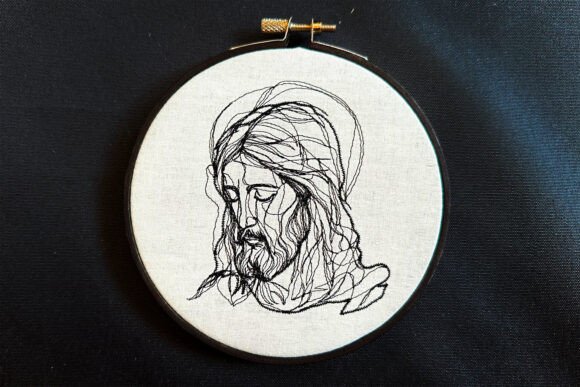
When I first opened the Jesus Face Machine Embroidery file on Creative Fabrica, what stood out wasn’t just the subject—but the quiet intention behind it. This isn’t a busy, ornate religious motif. It’s a one-line embroidery design that captures a downward gaze—gentle, grounded, reverent. As an embroidery designer who routinely evaluates hundreds of digital embroidery files for commercial use, I appreciate how rare it is to find a sacred image that avoids visual clutter while retaining emotional resonance. The line work feels intentional: not overly simplified, not excessively detailed—just enough contour and subtle shading to translate well across fabric without relying on dense fill stitches.
Fits Naturally Into Meaningful Handmade Categories
The Jesus Face Machine Embroidery doesn’t shout for attention—it invites reflection. That makes it especially effective on products where tone matters: baby blankets for baptism gifts, linen kitchen towels for faith-based home goods, or minimalist pillow covers for nursery decor. I tested it as a focal point on a cream cotton tote bag, and the result felt cohesive—not devotional in a performative way, but quietly personal. It also works beautifully scaled down for cap fronts or embroidered patches, where subtlety reads as craftsmanship rather than compromise.
Performance Across Common Embroidery Surfaces
In real-world stitching, this machine embroidery design behaves predictably—but with important caveats. Because it’s built as a one-line interpretation, stitch density stays low compared to heavily filled religious icons. That’s a strength when embroidering on lightweight knits (like baby onesies) or stretchy sweatshirt fleece—less pull, less puckering, cleaner edges. However, on dark fabric, thread color contrast becomes critical. I recommend testing with matte poly or rayon thread in ivory or soft ecru—not stark white—to preserve the humility in the gaze without glare.
On curved surfaces like caps, the clean outline holds up well, especially when hooped with medium-weight cutaway stabilizer. No satin-stitch borders or layered applique elements mean fewer alignment headaches during production. That said, if you’re planning to pair it with text (e.g., “He Is Risen” for Easter), treat the Jesus Face Machine Embroidery as your primary visual anchor—not a supporting element. Its presence carries weight, so balance matters.
Commercial Use Considerations for Sellers
For Etsy sellers and boutique owners, this Creative Fabrica embroidery file offers quiet differentiation. In a market saturated with floral monograms and trendy quotes, a tasteful, non-illustrative representation of Jesus’ face adds depth to seasonal collections—especially around Easter, but also year-round for faith-based gifting. Customers notice when embroidery feels considered, not copied. Because the design avoids literal realism or stylized artifice, it photographs well in natural light, enhancing product photography without needing heavy editing.
That said, be mindful of context. This isn’t a playful or cartoonish motif—it’s reverent. So pairing it with cheeky slogans or mismatched fonts can dilute its impact. Instead, lean into cohesion: neutral palettes, natural fibers, simple garment silhouettes. A linen apron with this embroidery file centered above the pocket reads as heirloom-quality. A terrycloth baby blanket with small-scale placement near the corner feels tender and intentional.
Practical Notes Before You Stitch
- Always test on scrap fabric—especially if using textured weaves like waffle-knit towels or looped terry.
- Review stitch density in your embroidery software. While the one-line nature suggests lighter coverage, confirm no hidden underlay or excessive jump stitches.
- Check hoop size compatibility early. Some versions may require a 4x4 hoop minimum; others scale cleanly to 3x3. Don’t assume—verify before digitizing for client orders.
- Compare mockups on both light and dark fabric. What reads softly on oatmeal linen may vanish on charcoal cotton unless thread contrast is adjusted.
- Use tear-away or cutaway stabilizer appropriate for your base fabric—not just “what’s on hand.” Lightweight stabilizer on knit sweatshirts prevents distortion; heavier stabilizer on stiff canvas ensures crisp lines.
- Inspect small details post-stitch: eyelids, brow contours, and the curve of the lips should remain legible—not blurred by thread tension or fabric movement.
- Confirm licensing terms directly on the Creative Fabrica product page. Commercial embroidery rights vary—even within the same shop—and clarity protects your handmade product business.
How It Elevates Your Finished Product
This Jesus Face Machine Embroidery doesn’t just decorate—it deepens. On a personalized gift, it signals care in curation, not just customization. For apparel decorators, it adds narrative value without sacrificing wearability. And for digital product sellers bundling design assets, its versatility across categories (tote bag design, sweatshirt embroidery, embroidered patch, nursery decor) makes it a smart addition to themed collections—especially those centered on peace, hope, or spiritual simplicity.
It won’t dominate a busy craft fair table—but it will draw the right kind of attention. The kind that lingers. The kind that leads to quiet questions, thoughtful purchases, and repeat customers who trust your eye for meaningful detail.
Final Thoughts for Embroidery Designers & Creative Entrepreneurs
If you’re evaluating the Jesus Face Machine Embroidery for real project use—whether for a custom apparel order, a seasonal Etsy launch, or a boutique’s curated lineup—approach it as you would any strong foundational design: assess mood first, then mechanics. Does its visual language match your brand voice? Does its construction support your most common fabrics and hoops? Does it elevate the product—or simply occupy space?
In my experience, this embroidery file earns its place not through flash, but fidelity: to form, to feeling, and to function. It’s not flashy Easter embroidery—it’s enduring embroidery. And in a handmade economy where authenticity sells, that distinction matters.