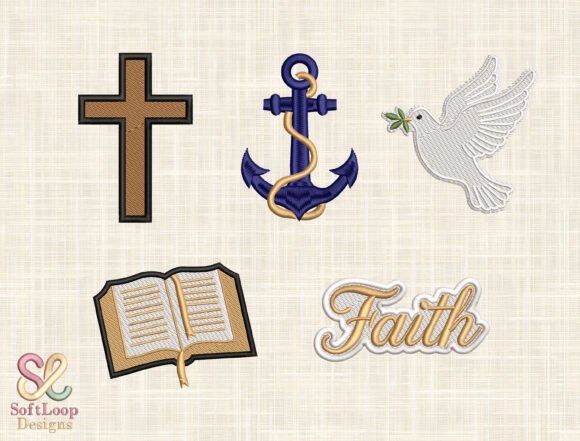
Christian Faith Embroidery Design
A Craft Fair Designer’s Real-World Review
As an embroidery designer who’s prepped over 200 craft fair booths—from downtown pop-ups to rural church bazaars—I approach every new design like a product scout: Does it stop browsers? Does it translate from screen to stitch? Does it hold up under booth lighting, fabric texture, and customer scrutiny? That’s exactly how I evaluated Christian Faith before committing thread, stabilizer, and display space to it.
First Impression: Reverent, Radiant, and Ready for Real Life
Right off the bat, Christian Faith lands as elegant and premium—not kitschy, not minimalist, not overly ornate. The description (“radiant white dove… ascending”) signals reverence without stiffness. It feels modern sacred: clean enough for a farmhouse kitchen towel, refined enough for a boutique pillow cover, and meaningful enough for a keepsake embroidered patch. That balance is rare—and valuable at craft fairs, where shoppers scan dozens of tables in under 90 seconds.
Where Christian Faith Shines on Handmade Products
- Tote bag design: Centered on a natural canvas or oatmeal linen tote, Christian Faith reads instantly—even from six feet away. The ascending dove creates vertical movement that draws the eye upward, making it stand out among flat floral or typographic designs.
- Apron embroidery: Positioned just above the pocket (not centered on the bib), it adds quiet intentionality—ideal for faith-based bakeries, church volunteers, or Christian homeschool co-ops. Customers consistently comment on “thoughtful details” like this.
- Tea towel embroidery: Works beautifully on medium-weight cotton or linen blends. The dove’s wings read clearly against textured weaves—unlike dense script-based designs that blur on terry or waffle cloth.
- Embroidered patch: A standout option. Cut-and-sew patches with Christian Faith sell well on denim jackets, backpacks, and kids’ Sunday school bags. Its symbolic clarity means no explanation is needed at the booth.
- Pillow covers & small pouches: At 4–5 inches wide, the design retains legibility and emotional resonance. It elevates a simple cotton pouch into a giftable handmade product—especially when paired with neutral thread (ivory on charcoal, soft gray on cream).
What Holds It Back (And How to Work Around It)
Christian Faith is described as “high-detail”—and that’s both its strength and its caution point. In practice, that means:
- Dense stitch areas may require tear-away + cutaway stabilizer combo on lightweight fabrics—or skipped stitches on textured tea towels if tension isn’t dialed in.
- Tiny details (feathers, wing tips, subtle halo glow) risk losing definition on curved cap surfaces or dark fabric unless thread contrast is carefully chosen (e.g., bright white thread on navy, not ecru on black).
- Small lettering (if included in the full “Celebrate the foundation of faith…” version) won’t resolve cleanly below 3 inches. Skip it entirely on caps or patches—let the dove carry the message.
- Stitch density demands testing: Run a sample on your most common fabric *before* batching. What looks luminous on a smooth cotton poplin may feel stiff or bulky on thick canvas market bags.
Selling Power: Attention, Value, and Booth Impact
At a craft fair, Christian Faith doesn’t shout—it invites. That’s strategic. While cartoonish or trendy designs get quick glances, this one earns longer stops, softer questions (“Is this from Scripture?” “Can you do it on my grandmother’s handkerchief?”), and repeat engagement. It supports brand consistency for makers who position themselves as intentional, quality-focused, and spiritually grounded.
Visually, it strengthens booth cohesion: Use it across three complementary products (e.g., ivory tea towel, charcoal apron, oatmeal tote)—same thread palette, same placement logic—and your table reads as curated, not cluttered. For Etsy sellers, it photographs exceptionally well: the dove’s clean lines translate crisply in natural light, and the symbolism encourages saves and shares.
Production Notes Every Embroidery Designer Should Follow
- Test on scrap fabric—not just the base, but your *actual* production fabric. Linen behaves differently than quilting cotton; terry toweling hides fine detail.
- Check thread contrast before stitching. White-on-white can read as ghostly; ivory-on-cream adds warmth without sacrificing purity.
- Review spacing between elements. If the dove ascends toward text, ensure breathing room—crowding undermines the sense of reverence.
- Confirm hoop size and whether the design fits comfortably within your standard hoops. Oversized hoops slow down booth prep and increase setup time.
- Inspect stitch density in software—look for overlapping satin columns or micro-fill areas that could cause puckering on lightweight fabrics.
- Use the right stabilizer for each substrate: cutaway for knits, tear-away for stable wovens, and ultra-stable for textured towels.
- Create at least one real mockup—not just a printable mockup. Drape it on your tote, pin it to your apron sample, hold it up in booth lighting. Does it hold its weight?
- Compare fabric colors side-by-side: a dove on oatmeal reads differently than on heather gray or deep indigo.
- Confirm commercial licensing before selling finished products. As a digital embroidery file, Christian Faith must be cleared for resale in physical form—not just as a download.
Final Verdict for Creative Entrepreneurs
Christian Faith isn’t just another religion faith embroidery file—it’s a conversation starter, a value amplifier, and a quietly confident craft fair product. It performs strongest when treated with intention: placed thoughtfully, stitched precisely, and presented alongside complementary handmade goods. For Etsy sellers building a niche around meaningful decor, for boutique makers curating spiritual lifestyle collections, and for embroidery business owners seeking evergreen, emotionally resonant designs—it delivers.
Just remember: high-detail doesn’t mean high-risk—if you honor the design’s reverence in your process, it’ll reward you in sales, stories, and shelf presence. Bring it to your next fair not as filler—but as focus.