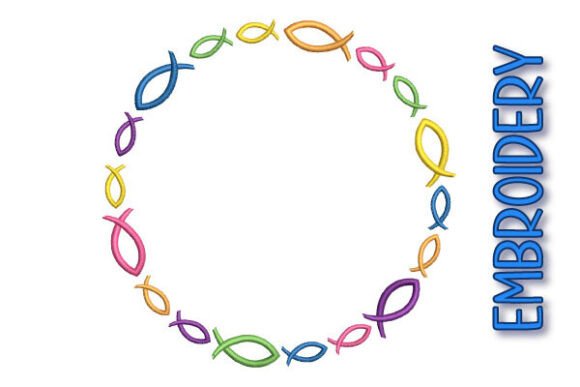
Christian Fish Frame Embroidery Design
A Practical Review for Small Business Merch & Branded Patches
As an embroidery designer who’s developed hundreds of commercial designs for cafés, boutiques, bakeries, florists, and faith-based small businesses, I approach every new machine embroidery design with two questions: Will it translate clearly on real fabric? and Will it strengthen — not distract from — the brand’s voice? The Christian Fish Frame Embroidery Design immediately stands out as a thoughtful, category-aware option in the Religion Faith space — but its real value lies beyond symbolism. It’s built for function.
First Impression: Classic, Friendly, and Professionally Balanced
From the title alone — “Christian Fish Frame Embroidery Design” — you know this isn’t abstract art or minimalist branding. It’s intentional, recognizable, and rooted in tradition. The description confirms it: a colorful circular frame with Christian fish symbols, offered in four sizes. Visually, that suggests symmetry, rhythm, and visual containment — all critical for small business merch where clarity trumps complexity. It reads as elegant but approachable, faith-centered but not overly formal. That duality makes it unusually versatile: equally at home on a handmade bakery apron and a boutique tote bag, without feeling out of place beside modern typography or earthy textures.
Where It Shines in Real Business Use
The Christian Fish Frame Embroidery Design excels where many religious motifs fall short — in scalable, repeatable, brand-integrated applications. Here’s how it performs across common small business needs:
- Embroidered patches: Its circular frame creates natural boundaries — ideal for iron-on or sew-on patches on staff jackets, dog-walking vests, or floral shop smocks. The four size options mean you can confidently scale it down to 2.5” for a subtle sleeve accent or up to 4” for a bold back patch on a canvas tote.
- Apron embroidery & cap embroidery: On curved surfaces like chef aprons or structured caps, the balanced weight distribution of the frame helps prevent distortion. Unlike linear scripture-based designs, this one holds its shape without stretching or thinning at the edges.
- Tote bag design & custom apparel: As a chest logo or lower-corner accent, it adds quiet meaning without overwhelming. Paired with a simple monogram or business name, it reinforces authenticity — especially for faith-aligned brands (e.g., a Christian counseling practice, a Catholic school bookstore, or a values-driven pet rescue).
- Product packaging accents & customer gifts: When stitched onto linen gift tags, cotton drawstring bags, or ceramic coaster sleeves, it elevates handmade product presentation. It signals care, intention, and alignment — key drivers of trust in Etsy and local markets.
Use With Intention: Where Caution Applies
No design is universally bulletproof — and the Christian Fish Frame Embroidery Design is no exception. For best results, consider these practical limits:
- Avoid ultra-small patch sizes (<2”) unless you’ve tested it first — fine details in the fish outlines may blur or fill in on dense stitch areas.
- Caps with deep front curves (like low-profile snapbacks) need careful digitizing adjustment; always test-stitch on the actual cap blank with proper stabilizer.
- Dark uniforms or textured fabric (e.g., heavy twill, bouclé, or fleece) demand high-contrast thread colors and possibly added underlay stitches — review thread color contrast before finalizing your palette.
- Frequent washing or heavy wear (e.g., restaurant staff aprons) requires tight stitch density and quality stabilizer — don’t skip the test run on your target fabric.
How It Builds Brand Identity — Not Just Decoration
This isn’t just a “religious design.” Used intentionally, the Christian Fish Frame Embroidery Design becomes part of your brand identity system. It signals shared values without requiring explanation — a quiet cue to customers who resonate with faith-rooted integrity, compassion, or community focus. For a small business, that builds instant recognition and emotional resonance. It also elevates perceived professionalism: when paired with clean typography and cohesive color blocking, it tells clients you invest in craftsmanship — not just messaging. And because it’s inherently frame-based, it integrates smoothly with other design assets: a matching monogram inside the circle, a complementary border on packaging, or even a simplified vector version for print use.
Essential Embroidery Designer Notes Before Production
Before sending the Christian Fish Frame Embroidery Design to production — whether for your own shop or a client project — follow these field-tested steps:
- Test it in black and white first — does the contrast hold? Are outlines legible at intended size?
- Check if it works cleanly at your smallest patch size (e.g., 2.25”) — zoom in on stitch paths and spacing.
- Review thread color contrast against your base fabric — especially on dark or heathered materials.
- Inspect spacing between fish elements and frame edges — tight gaps can cause thread breaks or skipped stitches.
- Confirm hoop size compatibility — circular frames often require round or square hoops; verify yours matches.
- Test on your actual fabric + stabilizer combo — texture changes everything, especially with satin or dense fill areas.
- Create a printable mockup for client approval — show it on a real garment photo, not just a white background.
- Compare it beside your other design assets — does it share rhythm, weight, and tone with your logo or typography?
- Confirm commercial licensing — since this is for small business merch, custom apparel, and commercial embroidery, ensure your digital embroidery file license permits resale and branded use.
The Christian Fish Frame Embroidery Design isn’t flashy — and that’s its strength. In a crowded market of generic logos and overdesigned merch, it offers quiet confidence, clear meaning, and proven adaptability. For embroidery shops, Etsy sellers, and small business owners building authentic connections through handmade product and custom apparel, it’s a smart, scalable, and soulful asset — as long as you treat it like the serious design tool it is.